
Updated 2 November 2026
Give a collection standing instructions
Standing instructions are the brief a new teammate would get on their first day, written down once: what belongs in this collection, how memos are named, which properties to set, what not to touch. People read them. AI assistants connected to Fieldwerk are handed them before they create, edit or file anything in the collection, and are told to follow them. That is what makes an assistant file things the way your team does instead of the way it guesses.
You can write instructions at three levels, and they add up:
Workspace instructions apply everywhere in the workspace.
Collection instructions apply to everything in that collection.
Notebook instructions apply to that notebook.
Write a collection's instructions
Open the collection and open its settings pane: click Collection settings at the top, or choose Manage collection from the collection's menu.
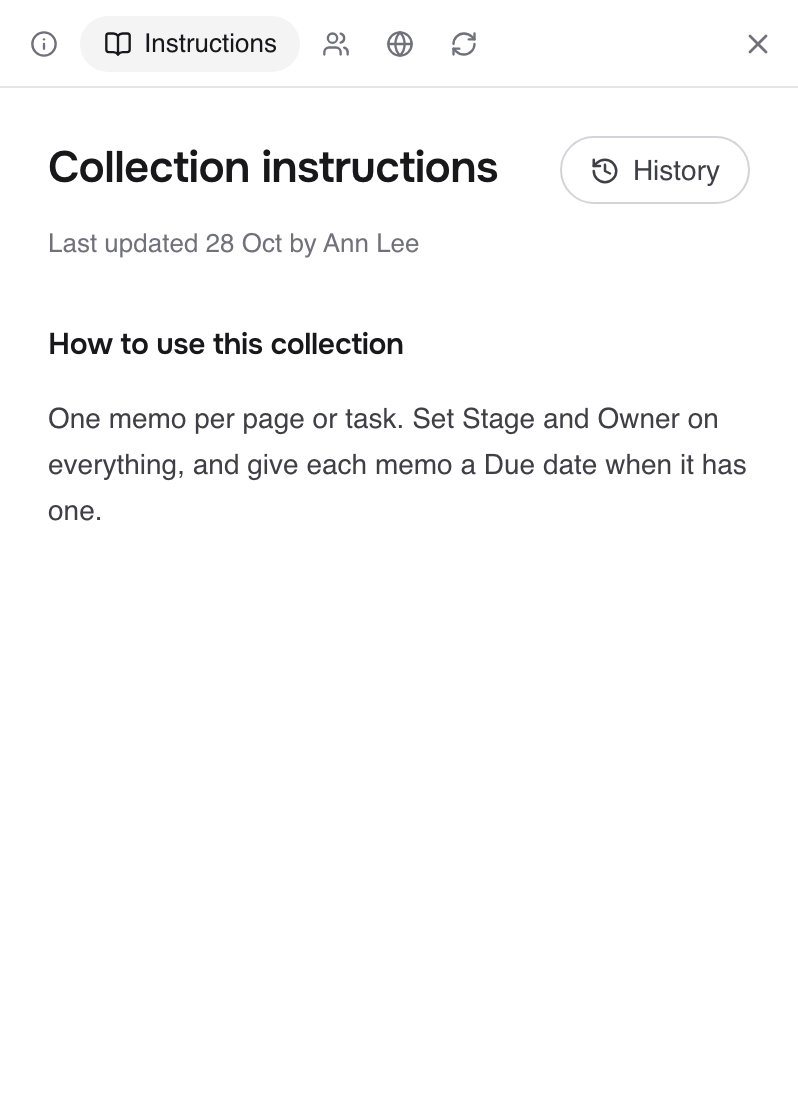
Open the Instructions tab.
Click Add instructions, write them, and click Save. To change them later, click the text to edit it.
You can also add them when you create the collection: click Add instructions for agents in the New collection dialog.
Earlier versions are kept, with who changed them and when, so a rule that quietly changed can be traced.
Write a notebook's instructions
Open the notebook's menu (Notebook options), choose Edit details, and fill in Instructions.
Write the workspace's instructions
Workspace owners and admins can open Workspace settings, go to General, and fill in Instructions. This is the place for rules that hold everywhere, such as how collections are named or what not to restructure.
What good instructions say
Keep them short and specific. Say what belongs, how to name and file things, which properties to set, and anything an assistant must not do. For example, for a collection of client meeting notes:
One memo per client meeting, titled with the date and client name. Set status to Draft until the notes are checked. Put action items in a task list at the end. Never delete a memo; archive it.
Or, for a help site, the kind of brief a writer would follow:
One page per question. Short answer first, then the detail. Plain English, NZ spelling, no em-dashes. Name controls exactly as the app shows them, in bold. Link to other pages instead of repeating them. Edit in place; never create a replacement memo.
A good habit: write them for someone who has never seen the collection. If a new teammate could follow them, so can an assistant.
Have your AI assistant do it
Ask a connected assistant (see Connect Claude to Fieldwerk or Connect ChatGPT to Fieldwerk) to draft the brief from what's already there:
In Fieldwerk, read the memos in my client collection, then write standing instructions so every meeting note has the same shape: date and client in the title, then attendees, decisions and action items. Show me the draft before you save it.Add one rule without rewriting the rest:
In Fieldwerk, add this rule to my client collection's instructions, keeping everything else as it is: "Set the owner property to whoever ran the meeting."