Updated 2 November 2026
What AI assistants can do in Fieldwerk
Anything you do with your memos and collections in the Fieldwerk app, your AI can do from a chat. The exceptions are account and workspace admin, such as billing, security settings and inviting members, and a few things you do yourself in the app, such as unlocking a memo, presenting it or downloading it.
So you can ask for "this week's client memos as a status update" and your AI reads the memos, writes the update and files it where your team will look. Ask it to work through a reviewer's comments and it edits the memo and replies in each thread.
Your AI works as you, with your access and nothing more. Every change it makes lands in the memo's history, so you can see what it did and undo it. Not connected yet? If you use Claude, add Fieldwerk from Claude's connector directory, as Connect Claude to Fieldwerk explains. Otherwise see Connect ChatGPT to Fieldwerk or Connect other AI tools to Fieldwerk.
Work alongside your AI without losing anything
It's told when a memo has changed. If someone edited a memo since your AI last read it, Fieldwerk tells your AI, so it can work from the latest version rather than write over their changes.
You can undo it in one click. If your AI changes a paragraph you're typing in, Fieldwerk shows a message saying so, with an Undo button.
You can see whose AI did what. On a memo, a connected AI shows with its person's name, such as "Ben's Claude". Its comments carry a badge with its name, and version history shows each change it made as the person's name followed by via and the AI tool. See See and restore earlier versions of a memo.
Capture what you'd otherwise lose
The useful parts of a conversation, a call or a document end up in a memo, filed and findable, without you leaving the chat.
Create a memo, or add to one you already have: a new section, a list item, a table row, a ticked task.
Edit just one section of a long memo, so the rest stays untouched.
Upload images and files, and attach links.
In Fieldwerk, save the decisions from this conversation as a new memo with a Decisions heading and an Open questions heading. Show me my collections and ask which one to file it in.Find and pull together
Your AI can search every memo you can open, list a collection, and find memos by their properties across your workspace. Then it reads what it finds and writes from it. You can also paste a memo or collection link straight into the chat; see Bring a memo or collection into any chat.
In Fieldwerk, show me my collections and ask which one to check. Then find the memos in it that are blocked or stuck, using their status if they have one, and tell me what each one is waiting on.In Fieldwerk, show me my collections and ask which one to use. Then read its most recent memos and draft a short status update from them as a new memo in that collection.Keep things organised
File memos into collections and notebooks, set properties such as status, owner and due date, apply tags, and save views such as a board grouped by status. Organising never counts against any limit.
In Fieldwerk, show me my collections and ask which one to tidy. Go through its memos and suggest an owner and a due date for each based on what it says, and which ones look finished. Show me the list, then make only the changes I agree to, moving finished memos into a notebook called Done and creating it if it isn't there.Run a review without a meeting
Your AI can read every comment thread on a memo, reply, resolve threads, assign them to people, and make the edits reviewers asked for.
In Fieldwerk, ask me which memo to work on. Read its comments and list the change each one asks for. Make only the changes I agree to, and reply in each of those threads saying what changed.Share and publish
Change a memo's link, invite people to a memo, share a collection with your workspace or publish it as a read-only page, within whatever you're allowed to do yourself. See Share a memo with a link or with people.
Build pages from your data
Your AI can write an artifact, a small HTML page in a memo that charts or tabulates the data files in a notebook and updates whenever they do. See Build an artifact that shows your data.
Set up the place it works in
It can create collections and notebooks, and write their standing instructions, the conventions every AI follows when working there. See Give a collection standing instructions.
A good habit is to give each collection standing instructions before your AI starts work in it, so it files and formats things the way your team does.
What it can't do
Reach anything your account can't.
Change billing, security settings or who's in your workspace.
Unlock a locked memo. It gives you a link to unlock it yourself.
Make changes without signing in. Before you approve the connection, an AI can only read memos whose link is open to anyone.
On Free, AI tools can make 200 content changes a day for each person in each workspace; what counts is on Choose a plan and manage billing.
The full, always-current list of tools is at fieldwerk.ai/connect/tools.
When you're not sure what to ask
Your AI asks Fieldwerk for guidance that fits where you are and suggests a next step. For a week of prompts to try, see Your first week with your AI assistant.
Manage connected assistants
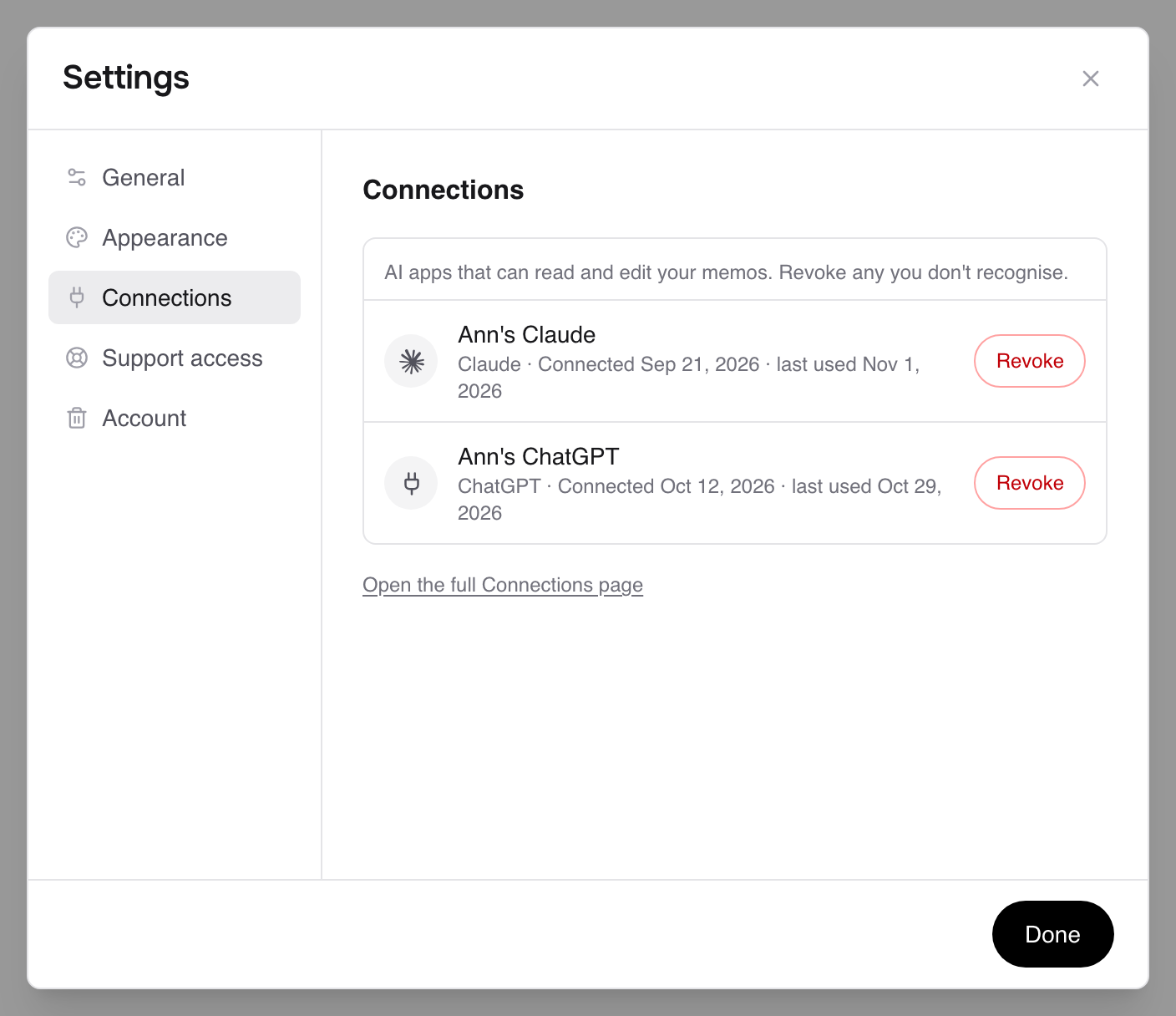
Open Personal settings and go to Connections. It lists every AI app connected to your account, with when it was connected and last used. Click Revoke on any you don't use or don't recognise.